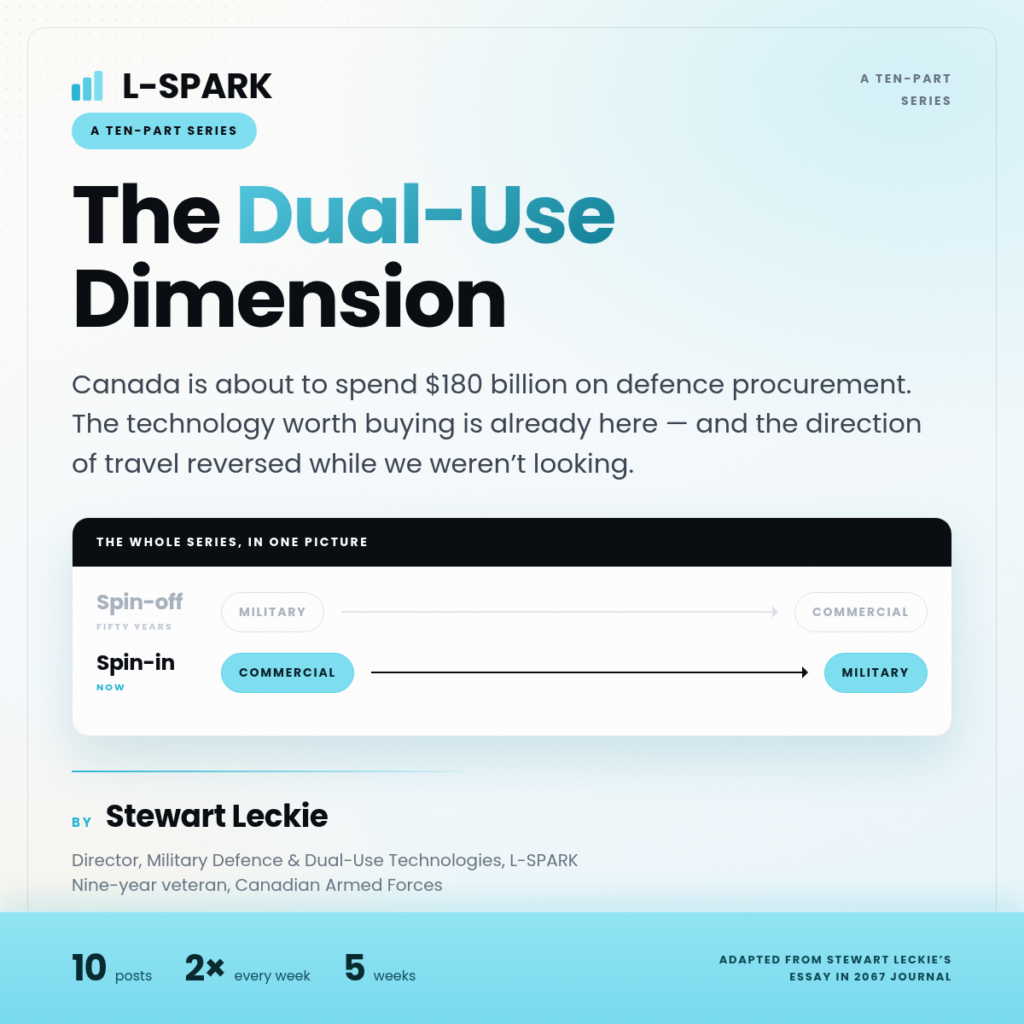
Canada is entering a new era of defence investment, with billions of dollars expected to flow into procurement and sovereign capabilities. At the same time, many of the technologies that could address Canada’s emerging defence needs are already being developed by commercial companies.
 For Stewart Leckie, Director, Military, Defence and Dual-Use Technologies at L-SPARK, that intersection is one of the most important opportunities in Canada’s technology ecosystem. We sat down with Stewart to learn more about his role at L-SPARK, what he sees happening in the dual-use space, and why Canadian startups should be paying attention.
L-SPARK: Stewart, tell us a little about your role at L-SPARK. What are you focused on?
Stewart: Day to day, I’m helping the innovation ecosystem understand the defence and military world — its language, how it communicates, what motivates it, and what it actually needs. Most founders and mentors have never had a reason to learn any of that, so defence stays unfamiliar, and unfamiliar things don’t get treated as real. My job is to make it familiar enough that a mentor can advise on it and a founder can weigh it as what it is: a legitimate revenue channel that delivers business benefit to the company and hard value to the people using the product at the end of the line.
The other side of the bridge is just as important. I’m building pathways for primes and other large organizations to explore this space responsibly, through accelerator and venturing activities, so they can engage with early-stage companies in a way that works for both.
I can do that usefully because I’ve sat in a lot of the stakeholder seats — nine years in uniform with the Cameron Highlanders, time inside the federal government, time on the venture side — and because I keep doing the research. Translation only works if you’ve lived on both sides of what you’re translating.
L-SPARK: You recently wrote about the “dual-use dimension.” What does dual-use mean in today’s technology landscape?
Stewart: The term isn’t new, and the old definition is still doing damage. Dual-use was coined for a world of spin-off: the military built something, matured it, and eventually released it to civilians on its own timeline. GPS, the internet, nuclear power. Canada has its own lineage there.
What’s changed is the direction of travel. The leading edge in machine learning, sensing, autonomy, batteries, communications and space now sits inside commercial companies, funded by commercial investors, improving on commercial schedules. No defence department on earth is out in front of it. Technology now spins in, not out.
So dual-use today doesn’t mean a military product with a civilian offshoot, or a civilian product with a military bolt-on. It means one capability with two sets of customers, and ideally no conversion step in between. RADARSAT is the clearest Canadian example: the same satellites, the same engineers, the same firm watching ice and crops for civilian agencies and ships off our coasts for military ones. Nobody converts anything. That’s the model, and most of our procurement machinery still assumes the old one.
L-SPARK: What does that shift mean for Canadian startups?
Stewart: The biggest gap I see isn’t technical. It’s imagination.
Most Canadians have very little exposure to the military. It isn’t part of daily life the way it is in some allied countries, and it isn’t part of how most founders, mentors or investors think about markets. So when I sit down with a company that is building something with a clear defence application, the founder often can’t picture it. Not because they lack creativity — these are creative people — but because they’ve never seen the scenario. They don’t know what a patrol looks like, what a logistics chain needs, what a soldier is actually carrying. Without that exposure, the ability to imagine a useful dual-use business case is limited.
That’s fixable, and it’s a big part of what I do. Once a founder understands the real problems and trends on the defence side, the connections tend to come quickly. The capability was already there. What was missing was a reason to point it in that direction.
L-SPARK: Where do you see the biggest opportunity?
Stewart: The Defence Industrial Strategy lays out the roadmap in three words: build, partner, buy. The order matters.
Build is first because Canada needs sovereign capability — things we can make, maintain and improve ourselves. Partner is second because none of us can do this alone. Government, primes, startups, universities and investors each hold a piece of the picture, and the silos are exactly what’s held us back. Success takes the other perspectives at the table. Buy is third for a reason: it’s what you do when the first two aren’t available, not where you start.
For a Canadian startup, that ordering is the opportunity. A company that can build sovereign capability and partner well — with a prime, with a program, with an accelerator — is positioned at the front of the strategy rather than at the end of the queue. That’s the space L-SPARK is working in.
L-SPARK: What inspired your latest article?
Stewart: Three things stacked on top of each other. The first is the change in direction — the shift from spin-off to spin-in, and the fact that most of our institutions were built for the old direction. That alone is worth writing about, but it isn’t the whole problem.
The second layer is capacity to execute. Does Canada have what it needs to build these capabilities? I think the honest answer is yes. The money, the allies, the universities, the critical minerals, the talent, the capital — the ingredients are not in question.
The third layer is ability to execute, and that’s a systems question. If a Canadian company builds something excellent that the Armed Forces need, can the organizations and systems it was built for actually pick it up? Can they find it, evaluate it, buy it, and field it while it’s still current? That’s the layer nobody was talking about, and it’s the one that decides what the money actually buys. That’s the question I try to answer in The Dual-Use Dimension.
Read Stewart’s full article, “The Dual-Use Dimension,” in 2067 Journal: https://2067journal.ca/the-dual-use-dimension/
Coming soon: A deeper look at dual-use technology
This conversation is just the beginning. Coming soon, L-SPARK will launch a 10-part blog series exploring the dual-use opportunity in greater depth, from the technologies and sectors shaping the landscape to the challenges and opportunities for Canadian startups looking to enter the defence market.
Stay tuned as Stewart takes a closer look at what the rise of dual-use technology means for Canada’s innovation ecosystem, and where the biggest opportunities may be found.